Alexander Tsepkov Project Portfolio
Software developer and data geek with 18+ years delivering web, mobile, and defense systems that ship to production. My focus is on analytics platforms, APIs and developer tooling. My open-source work ranges from compilers and automation frameworks to GIS data products. I weave AI-assisted workflows into day-to-day engineering to accelerate delivery and quality.
Leveling Up With Generative AI
 I've been using generative AI to get up to speed on unfamiliar topics for a while now — real estate markets, new programming frameworks, financial concepts I'd never encountered. My approach was intuitive but messy: keep asking questions, keep digging, rephrase when I don't understand. I've written before about how three rough prompts beat one perfect one, and that's basically what I was doing. Iterating my way to understanding without a system.
Tom Bilyeu explained the same idea better than I could. His version: ask AI to explain a topic like you're 5 years old. Then like you're 12. Then a high school senior. Then at a college level. Each pass builds on the last, and within a couple hours one could go from knowing nothing to having a working mental model that's good enough to be above average in a given niche. AI compresses the learning curve. It boils down weeks of stumbling through a new domain into the essential mental models you need to be functional. Not expert-level, but functional. And for most situations, functional is all you need to start. It's literally like the age-old Matrix meme of Neo downloading Kung-Fu into his brain.
The Great Equalizer
A first-generation investor with no mentor, no MBA, and no connections can now sit down with AI and evaluate a real estate deal at a level that used to require years of experience. Not perfectly, but well enough to know whether the numbers deserve a closer look or if they should walk away. Going from "I don't even know where to start" to "I can have an intelligent conversation about this" used to take months. Now it takes an afternoon.
Same thing in every other domain. You need to understand a legal contract but can't afford a $500/hour attorney for a preliminary review? AI gets you to "I know which clauses to worry about and which questions to ask my lawyer." You're learning a new programming language for a project at work? AI gets you writing functional code in days instead of spending a month on tutorials.
The pattern is always the same: AI pulls you from "completely lost" to "dangerous enough to be useful." It doesn't make you an expert. It makes you functional. And functional is the entry ticket that used to cost a fortune. One caveat I should point out here, especially when it comes to using AI for legal paperwork or financial decisions: the advice AI gives isn't always correct, but it's often presented in a way that bypasses our BS meter, especially if we're a novice in a given field. It's the verbal equivalent of the uncanny valley effect, the advice seems sane on the surface but something doesn't add up, and it often requires an expert to find the flaw (or asking the same question in multiple ways to break through the BS).
The Bell Curve Problem
Think about any skill as a bell curve. Most people cluster around the middle — competent enough, decent at the basics, nothing special. A few experts sit way out on the right tail. And the beginners are on the left, still figuring out which way is up. AI, on its own, performs somewhere around the median. It's the world's most confident B-student. Decent at most things, excellent at nothing, and terrible at the edge cases that matter most. The midwit meme becomes uncomfortably relevant here.
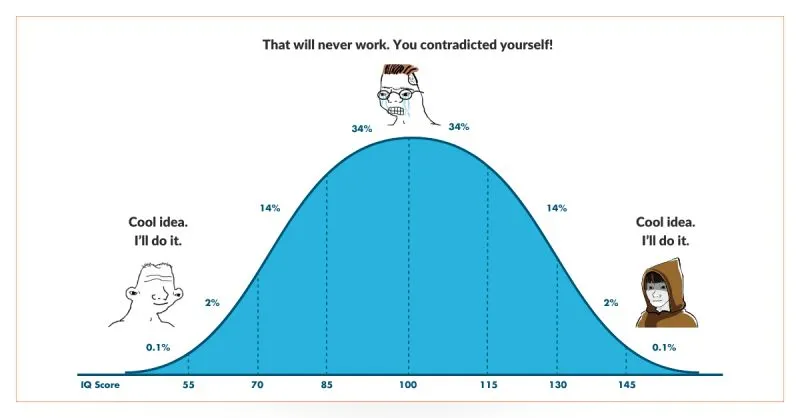 If you're a beginner, AI is a miracle. It pulls you from the left tail toward the middle of the curve. You go from "I don't know what I don't know" to "I have a working mental model" in a fraction of the time. The distance covered is enormous.
If you're a genuine expert, AI is a force multiplier. You already have the taste and judgment that AI lacks. You use it to move faster, handle the tedious parts, and extend your reach. I've written about this separately, the short version is that expert + AI is the most powerful combination available right now.
But if you're in the middle? If you're the person who's been doing the job for a few years and considers yourself pretty good at it? That's the uncomfortable spot. Because AI performs at roughly your level — for free, instantly, and without needing a salary. The people most threatened by AI aren't the beginners (who have everything to gain) or the experts (who have the judgment to stay ahead). It's the median performers who've been coasting on "good enough" - the midwits on the bell curve. That's where the panic is coming from. This is also where we see most of the resistance to AI because these individuals have to learn a new way of doing things without immediate benefit. AI can do their job almost as well, but when AI is wrong, they don't always have the intuition to notice it.
Learning at Compression Speed
The part that excites me most isn't using AI to do work. It's using AI to learn faster. When I'm exploring a niche, I start by asking the AI about the basics to build a mental model in my head: a scaffold. I then scrutinize that scaffold until I'm confident enough that it's stable. This is where using multiple agents and even multiple AI providers help, as they'd be able to fix incorrect assumptions. I then work through several examples to make sure I understand the fundamentals - drill down into edge cases. AI allows me to learn in a way similar to how Tim Ferriss suggested in his 4-Hour Chef book but on steroids, no flash cards needed.
AI doesn't replace the learning. It replaces the hours of fumbling around before the learning starts. It gets you to the starting line faster so you can spend your time on the part that actually requires a human brain — applying what you've learned, making judgment calls, connecting dots between domains. Best of all, with the right prompts, AI tailors the learning curriculum to how YOU learn. This works fine with casual, one-off prompts. But I've found five specific modes that turn AI into something closer to a thinking partner. This is how I actually use it.
How to Actually Use AI as a Thinking Partner
Most people use AI like a search engine: type a question, get an answer, move on. That works for simple lookups, but it barely scratches the surface. The real value comes from using AI as something closer to a consultant — an endlessly patient one that never watches the clock and has no ego invested in being right. Four modes I keep coming back to, plus one rule. The following framework explains my approach to getting to intermediate level in any field within 1-2 hours.
This content is free — all I ask is that you create an account to continue reading.
Continue reading on Investomation →